
The TaLYK5–TaDSK2a module serves as a molecular switch between plant growth and immunity during fungal attack
作者: 张越 审稿人:魏育明 时间: 2026-08-25 点击次数:次
https://doi.org/10.1073/pnas.2612340123
Proc Natl Acad Sci U S A. 2026 Aug 25
Yu Wu, Dan Yang, Haibin Zhao, Qin Wu, Yue Li Xinyuan Li, Jian Ma, Qiantao Jiang, Yazhou Zhang, Yunfeng Jiang, Pengfei Qi, Xiaojie Wang, Yuming Wei, Qiang Xu
Abstract
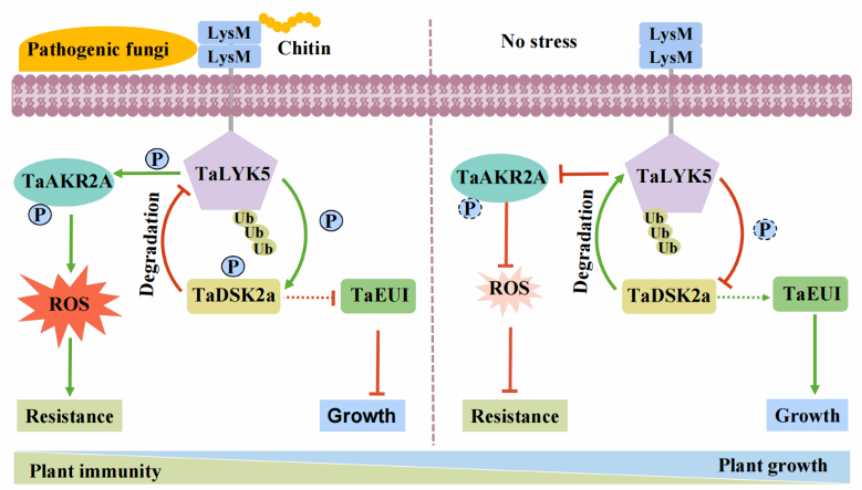
Plants are constantly challenged by pathogenic microorganisms that threaten growth and survival. While the individual signaling pathways involved in these immune responses have been well characterized, how plants balance growth with rapid pathogen perception and immune signal transduction remains largely unclear. Here, we report that the receptor-like kinase TaLYK5 receptor of wheat (Triticum aestivum) recognizes chitin on the fungal pathogen Puccinia striiformis f. sp. tritici (Pst) and initiates a cascade of events that increase immune response while reducing growth. TaLYK5 acts as a positive regulator of defense by phosphorylating the ankyrin-repeat–containing protein TaAKR2A, which supports reactive oxygen species (ROS) production and defense responses. In parallel, activated TaLYK5 negatively regulates growth responses by phosphorylating serine residue S234 in the ubiquitin-binding protein TaDSK2a, blocking its ability to degrade TaLYK5. In the absence of Pst, TaAKR2A does not initiate ROS signaling and immune responses and TaDSK2a associates with polyubiquitin chains on TaLYK5 to mediate its degradation, suppress TaLYK5-mediated plant defense. Meanwhile, TaDSK2a regulates GA accumulation to promote plant growth, possibly by accelerating the degradation of TaEUI, a gibberellin (GA)-deactivating enzyme. These findings demonstrate that the TaLYK5–TaDSK2a module functions as a molecular switch that dynamically regulates the trade-off between plant immunity and growth.
Keywords
growth and immunity; molecular switch; stripe rust; wheat.
Acknowledgments
We thank Prof. Qixin Sun and Mingming Xin (China Agricultural University) for providing pBUE411 vector. This study was supported by the National Natural Science Foundation of China (32225041; 32572839; 32421004), Basic Research Zone for Crop Science in Sichuan Province (2026ZWTQZD002), the Sichuan Science and Technology Program (2024NSFSC0405), China Agriculture Research System (CARS-3).

地址: 四川省成都市温江区惠民路211号 四川农业大学小麦研究所 邮编: 611130 电话: 028-82650350