
Biosystematics and Taxonomic Treatment of Three New Kengyilia Species in the Triticeae (Poaceae)
作者: 吴丹丹 审稿人:魏育明 时间: 2026-07-27 点击次数:次
https://onlinelibrary.wiley.com/doi/10.1002/ece3.74040?af=R&msockid=0eff260a31f16cb1031b30c030a46d15
Ecology and Evolution, 2026; 16:e74040 https://doi.org/10.1002/ece3.74040
Xiao-Yang Pan, Shuang-Dan Li, Chang-Bing Zhang, Jia-Yue He, Yuan-Yuan Lu, Ting-Ting Zheng, Ying-Hui Li, Li-Li Xu, Hai-Qin Zhang, Hou-Yang Kang, Dan-Dan Wu, Yong-Hong Zhou
ABSTRACT
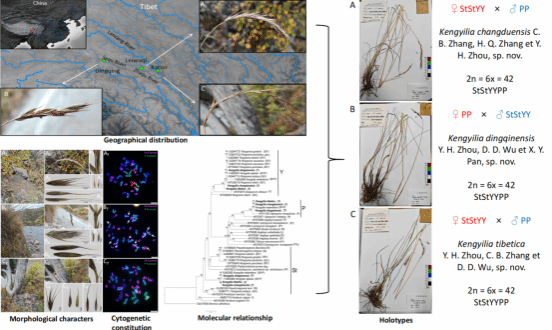
In the present study, we discovered and investigated three new species of Kengyilia (Triticeae, Poaceae): Kengyilia changduensis C. B. Zhang, H. Q. Zhang et Y. H. Zhou, Kengyilia dingqinensis Y. H. Zhou, D. D. Wu et X. Y. Pan, and Kengyilia tibetica Y. H. Zhou, C. B. Zhang et D. D. Wu, in Changdu, Tibet, China based on morphological, cytological, and molecular data. Each species is morphologically characterized and distinguished from existing Kengyilia species by smooth internodes, glumes oblong- lanceolate and awns 2mm, lemmas pubescent and awns 5–10mm of K. changduensis, the lower part of the spikes is sparse, internodes hairy, glumes covered with soft hairs, awns 2mm, lemmas oblong and awns 5mm of K. dingqinensis, and internodes hairy, glumes oblong-lanceolate and awns 2–6mm of K. tibetica. The genomic in situ hybridization results confirm that K. changduensis, K. dingqinensis, and K. tibetica are allohexaploid with StStYYPP genomic constitutions. Phylogenetic analyses, based on GBSSI nuclear gene and chloroplast genome sequences, suggest that K. changduensis, K. dingqinensis, and K. tibetica were closely related to genera Pseudoroegneria, Roegneria and Agropyron, and the Roegneria served as the maternal donors during its polyploid speciation of K. changduensis and K. tibetica, and Agropyron served as the maternal donors of K. dingqinensis.
KEYWORDS
Kengyilia, genome, StYP, morphology, phylogenetic relationship, new species
ACKNOWEDGMENTS
We thank anonymous reviewers for their very useful comments on this manuscript. We thank X. F. Deng of Sichuan Academy of Grassland Science for the wild germplasm collection in Tibet. We also thank Prof. X. Fan of Sichuan Agricultural University and PhD students H. Yan and X. Liang for insightful suggestion for this study.
FUNDING
This work was supported by the Science and Technology Department of Sichuan Province (2026NSFSC0206), National Key Research and Development Program of China (2024YFD1201202), National Science and Technology Major Project (NK20220607).

地址: 四川省成都市温江区惠民路211号 四川农业大学小麦研究所 邮编: 611130 电话: 028-82650350